
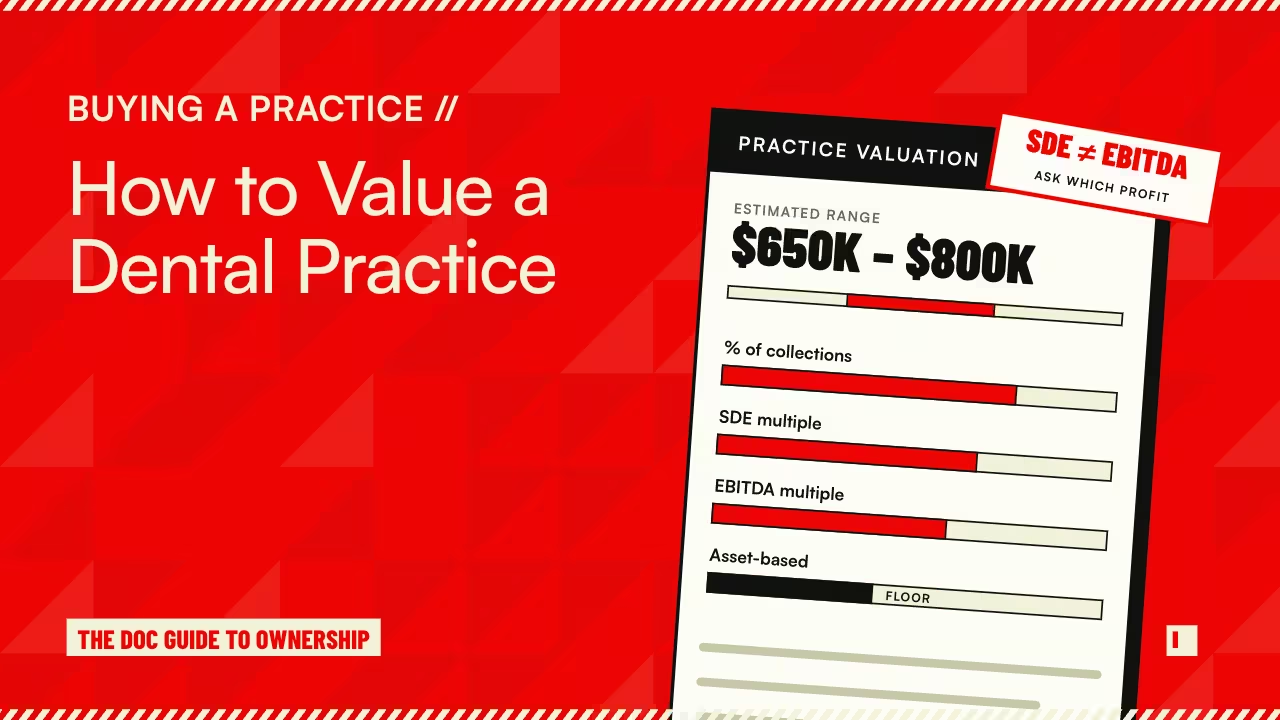
What is a dental practice valuation?
A dental practice valuation is an estimate of what a buyer should pay for a practice's equipment, patient base, and future earnings.
“Valuation” and “appraisal” are often used interchangeably. An appraisal usually means a report created by a credentialed appraiser. A valuation can be as informal as a broker’s back-of-the-napkin estimate to get a listing live. Whatever the source, it’s important to audit the report's underlying math and assumptions before making an offer.
💡A dental appraisal values the practice itself, and a real estate appraisal values the building. If you're buying the building too, you’ll need both.
When should you get a valuation?
A dental practice valuation is part of the process anytime you're paying for an existing practice. This includes:
- Purchase: Acquiring 100% of the practice.
- Buy-in: Purchasing a partnership share in your current practice.
- Buyout: Acquiring equity in scheduled stages over time.
Who pays for a dental practice appraisal?
Usually the seller. Sellers commission a valuation so they have a report to show buyers, and it's often prepared by their broker. Brokers are typically paid when the deal closes, so a higher price works in their favor. That doesn't make the report wrong, but it isn't neutral.
You can also hire your own appraiser. An independent appraiser charges a flat fee and doesn't earn more if the number comes in higher. If the seller's report is the only valuation on the table, get your own before you make an offer.
How much is a dental practice worth?
There's no fixed price for dental practices, or universal percentage of collections, no matter what a broker tells you. Brokers and dental CPAs commonly cite 65% to 80% of one year's collections for a general practice. For a practice collecting $1 million a year, that's roughly $650,000 to $800,000. Local sales vary a lot, so treat that as a ballpark, not a target.
Where a practice lands in that range depends on two things:
- Valuation method: Each method rewards different strengths. A practice with large collections but a bloated overhead can look great under one method and mediocre under another.
- Who’s also bidding: If a DSO (dental service organization) is in the mix, they can often pay more because they spread their costs across many locations. Be aware of a seller using a corporate offer to anchor a valuation your cash flow can't support.
Dental Practice Valuation Methods
Valuing a dental practice usually involves four main methods. Each method starts from a different place, so two appraisers can analyze the same practice and come up with different numbers. Most appraisers blend two or three of these into a final number.
Percentage of Collections
Formula: One year of collections × a percentage
Recent local dental practice sales set the baseline percentage. Percentages can increase with low overhead or a busy hygiene schedule, while things like a heavy PPO dependence can bring it down.
Where it falls short: Collections show revenue of the practice, not profit. Two practices that each collect $900k cost the same at the same percentage, even if one has much higher overhead costs.
Earnings multiples (SDE and EBITDA)
Formula: One year of profit × a multiple.
The multiple represents how many years of profit you’ll pay for upfront. Practices with predictable earnings command higher multiples because the transition carries less risk. Appraisers can measure profit in two ways:
- SDE (seller's discretionary earnings): the total annual benefit to one owner-operator before debt and taxes, including their pay for clinical dentistry, perks, and add-backs. Buying on SDE is buying a job plus a business. Part of that money is your own salary, which you'll still have to work to earn. That's why buyers pay for fewer years of it up front. This often results in a lower multiple.
- Adjusted EBITDA (earnings before interest, taxes, depreciation, and amortization): adjusted to subtract a market-rate salary for a doctor to do the dentistry. Buying on adjusted EBITDA is buying just the business. The clinical work is already paid for, so buyers pay for more years of it up front, and it gets a higher multiple.
The catch: A multiple means nothing until you know which profit it's applied to. Put an EBITDA-sized multiple on SDE, and you can pay more than double what the practice supports. If a listing gives a multiple, ask which profit it's based on.
Capitalized excess earnings
Formula: (EBITDA − Equipment Return) ÷ Risk Rate + Equipment Value
This method separates practice earnings into two categories: a return on physical equipment and the remaining “excess earnings”. The excess represents the practice’s goodwill (patients, referral relationships, staff, and reputation), which is discounted based on transition risk.
The vulnerability: The appraiser picks the risk rate, and a lower rate means a higher price. A few points can swing a practice’s value significantly.
Asset-based approach
Formula: Tangible assets (equipment, supplies, and build-out) + (active patients × a value per patient)
This method ignores profit and equipment is usually counted at fair market value, not book value. The per-patient value depends on things like payer mix and how many patients are on recall.
The reality: Low equipment value can mean an aging server or chairs you need to replace in month one, right when cash is the tightest.
Important Numbers to Check in a Valuation
Every earnings method runs on a normalized P&L: the seller's financials, adjusted to show what the practice will make under your ownership. Check three areas closely:
- Doctor salary: Valuations estimate the dentist's compensation. If the estimate is too low, the practice’s profitability may be inflated.
- Add-backs: Adding back personal expenses, like a car lease, is standard. Watch for sellers who add back costs you'll keep paying after you buy, like marketing.
- Take-home vs. profit: What a seller says they take home and what their tax return shows can be very different numbers. Profit on paper often goes to debt payments and taxes before it ever reaches their bank account. Build SDE from the P&L and tax returns, not from what the seller remembers.
Sample Dental Practice Valuation
To see how these practice valuation methods compare, here is a sample solo practice evaluated under each framework (illustrative figures only).
- Annual net collections: $1,000,000
- SDE (total benefit to the owner-operator):: $360,000
- Doctor pay (assumed market rate): $220,000
- Adjusted EBITDA (profit after paying a doctor): $140,000 ($360K SDE − $220K doctor pay)
- Tangible assets (equipment, supplies, and build-out): $100,000
- Active patients (seen within 18 to 24 months, with a hygiene visit): 1,600
Profit-based methods set a valuation range of $620K to $720K, with the asset-based method as a $500K low-end check. Any asking price above this range represents a premium that requires clear justification.
A fair price vs. an affordable deal: A valuation tells you what the practice is worth. It doesn't tell you whether you can afford it. Whether the cash flow can cover your living expenses and your loan payments is a separate test.
Frequently asked questions
How much does a dental practice valuation cost?
For a typical solo practice, a formal independent appraisal commonly runs about $1,500 to $4,000. Larger practices, partnerships, and more detailed reviews cost more, sometimes $10,000 or beyond. A broker's valuation may be free if the seller lists with them, but the broker is usually paid when the practice sells.
What's the rule of thumb for valuing a dental practice?
Brokers and dental CPAs commonly cite 65% to 80% of one year's collections for a general practice.
Who performs dental practice appraisals?
Usually independent appraisers with credentials like CVA (Certified Valuation Analyst), ABV (Accredited in Business Valuation, a credential for CPAs), or ASA (Accredited Senior Appraiser). Brokers also prepare valuations, but they're typically paid when the deal closes.